
- Home
- encyclopaedia ibiza, encyclopaedia ibiza
- The beaches of Ibiza
Your search results


May 13, 2026

The beaches of Ibiza
Published on May 13, 2026 by Neverland Properties
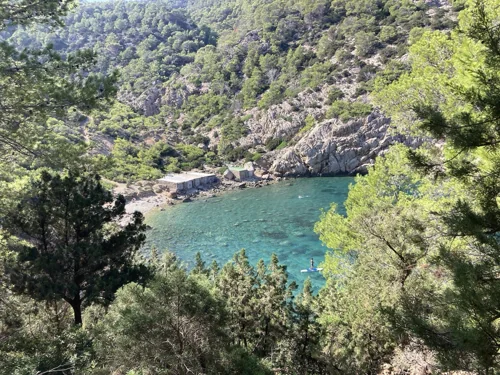
Ibiza has approximately 210 kilometres of coastline and just over fifty catalogued beaches and coves. The figure alone says little. What defines the Ibizan coast is not the quantity but the radical diversity of its forms: long sandy stretches with full amenities, rocky coves reachable only on foot or by boat, urban beaches with promenades, corners beside fishermen’s huts that time seems to have forgotten. Understanding how that coastline is distributed is the first step towards choosing well.
How are Ibiza’s beaches distributed by type, character and use?
The southwest and south coasts, which belong largely to the municipality of San José, hold the greatest density of sandy beaches on the island: more than 80 kilometres of coastline and 32 beaches, including the most internationally recognised. The westward orientation of this coast is also the reason it produces the best sunsets. The east coast, in the municipality of Santa Eulalia, has a high number of small sandy beaches, calm, family-friendly, well positioned to catch the morning sun. The north coast, in San Juan de Labritja, is the wildest and least accessible: continuous cliffs, few sandy beaches, hard-to-reach coves that are precisely the ones most prized by those who know them. The northwest has the lowest beach density of the entire island: a rugged, irregular coastline where the cliffs leave room only for a handful of small coves of exceptional character.
For a guest arriving at a luxury villa, this geography has one direct practical implication: the ideal beach is not the most famous one or the nearest one, but the one that matches the kind of day you want to have.
Read more
What sets Cala Conta, Cala Jondal and Ses Salines apart in terms of size, atmosphere and crowd?
Cala Jondal, Ses Salines and Cala Conta are the three most recognised beaches in Ibiza, each with a radically different profile, crowd and experience.
Cala Jondal, on the south coast of San José, is a pebble beach with a boardwalk leading into the water. Its character has been built entirely by the restaurants around it. El Tropicana, one of the first to open at the cove, with decades of history and a loyal clientele of second-home residents and returning visitors, is the reference point for the long leisurely lunch by the sea: you eat at the restaurant, and sun loungers can be reserved for guests. Casa Jondal represents the newest and most refined proposal at the cove, covered in detail in the gastronomy entry. At the other end, Blue Marlin and Jemanja complete the lineup, the latter long owned by an Ibizan family who kept it open year-round and preserved its spirit when it became part of the Blue Marlin group. The atmosphere at Cala Jondal is sophisticated and unhurried at the same time, with yachts anchored in the bay and the easy rhythm of a Mediterranean noon.
Ses Salines is something else entirely. A long stretch of fine white sand inside the Ses Salines Natural Park, with views to Formentera on the horizon and sailing boats anchored in front. The salt that gave the beach its name is still present in the landscape: the loading jetty and the salt pans are visible from the access road. La Nave Salinas, a former industrial salt warehouse converted into an exhibition space by collector Lio Malca, is a singular presence in that setting. In winter, the area lends itself to walks towards the towers and the quieter coves at the far end of the beach, ten or fifteen minutes on foot. In summer, Sa Trinxa, legendary for its festive atmosphere and its music, its history woven into the Ibiza scene of the early 2000s, had its sound equipment seized last summer when authorities applied a regulation dating back two decades, an episode that generated wide debate on the island. El Jockey Club, another long-standing family institution, and El Beso, a newer addition, complete the beach’s offering. Ses Salines draws a cosmopolitan, international crowd.
Cala Conta, also known as Platges de Comte, rewards a different kind of visit. Come early, walk the coastal path along the rocks, swim in the clearest water on the southwest of the island, eat well at one of the locally owned restaurants, and stay long enough to watch the sun go down directly in front of you. El Cala Escondida, a free-spirited chiringuito at the far end of the cove, and the Sunset Ashram, with decades of history here and the place that has done more than any other to define the sunset ritual on this stretch of coast, give Cala Conta its character. The rocky shoreline surrounding the beach has beautiful walking paths that lead to fishermen’s huts carved into the cliff face, reached through access points that very few visitors ever stumble upon.
Read more
What is the difference between a chiringuito and a beach club in Ibiza?
In Ibiza, a chiringuito is a seasonal temporary structure with no fixed construction, regulated by coastal law; a beach club operates with a restaurant licence and a permanent structure. The difference is not just one of size or price; it is a legal and structural distinction that determines what to expect from each.
A beach club offers a full gastronomic proposal, table service, and typically manages its own sun loungers and daybed areas as part of an integrated experience. At the busiest beaches, the best positions are booked days or weeks in advance in July and August. For guests arriving with a villa, the concierge has established relationships with these venues and can manage the reservation with the right context. This service is covered in detail in the Housepitality and concierge entry.
Read more
Which beaches in Ibiza have the best sunset views?
The best sunsets in Ibiza are concentrated along the west coast, which faces the open Mediterranean: Cala Conta, Punta Galera, Cala d’Hort and Cala Benirrás are the four reference points, each with its own quality of light and atmosphere. It was Café del Mar in San Antonio, open since 1980, that put the Ibizan sunset ritual on the world map. From the nineties onwards, its chill-out sessions facing the sea turned that moment of the day into an experience with an identity of its own, copied and exported across the planet.
Cala Conta is the undisputed reference. The small islands on the horizon, the light on the water, the slightly wild coastal profile: it is a combination that is hard to match anywhere else in the Mediterranean. The sun sets directly ahead, which makes it almost unreal on the best summer evenings.
Read more
What is Punta Galera and why do Ibizans go there at sunset?
Punta Galera, near Cala Salada, is where Ibizans go when they want a sunset without crowds. The site is a singular rock formation that creates horizontal natural platforms, almost like terraces shaped by the sea, where you can lie at water level with a privacy that Cala Conta cannot offer in July and August. The access is slightly more demanding, which acts as a natural filter.
Which other coves stand out on Ibiza’s southwest coast?
The municipality of San José holds more than thirty beaches and coves across its 80 kilometres of coast, each with a very different profile: from Cala Vadella, sheltered and familiar as a small Mediterranean village, to Cala Molí, where entering the water over the rocks puts off the less determined and keeps the cove strikingly quiet even in August.
Cala Vadella tends to catch visitors off guard: it feels more like a small Mediterranean fishing village than a beach. Restaurants sit right at the water, their terraces looking onto the enclosed bay. The sea is calm and shallow, among the most reliably gentle on the island, and the cove has the kind of unpressured atmosphere that brings second-home owners and first-time visitors alike back every year.
Cala Carbó is compact and discreet, with two local restaurants where you can eat paella or fresh fish without ceremony. Its regulars are residents and guests of nearby luxury villas who want exactly that: quiet and honest cooking by the sea.
Cala d’Hort is defined by what sits directly in front of it: the islet of Es Vedrá and, beside it, Es Vedranell. The beach faces these two rock formations head on, with water clear enough to make the view from the shoreline one of the most striking on the entire southwest coast. For more on Es Vedrá, see the dedicated entry in this encyclopaedia.
Cala Molí has a particular history. For years it had no sun loungers or services, by order of the local authorities who wanted to preserve its unspoilt character. It always had a restaurant, similar to the one at Cala Carbó with a terrace and a pool, but the venue changed hands repeatedly over about fifteen years without ever quite finding its tone. Around three years ago it settled definitively as El Silencio, a name that says it all. The team understood the spirit of the cove: discretion, respect for the setting, no noise. Getting into the water over the rocks is not comfortable, which acts as a natural filter and keeps the cove very uncrowded in summer. It is beautiful. The cliff to the left casts reflections on the water that produce shifting tones of blue and green, different at every hour of the day.
Cala Tarida has exceptional blue water and sand that invites you to stay. It has beach service and enough restaurant options to sustain a full day. It is ideal for children, and the light on the water in late afternoon is something special.
Cala Gracioneta is tiny, almost entirely taken up by the restaurant that shares its name, sheltered by pines that reach right to the water. You don’t come here to lie on the sand; you come to explore the rocky pockets, look into the crevices, watch what moves in the shallows. Together with Cala Salada, the two form one of the most striking stretches on the entire coast.
Read more
Which beaches in Ibiza are the hardest to reach, and why is the effort worth it?
Some coves in Ibiza are not publicised, have no clear signage and require more than parking and walking down. That difficulty is precisely what protects them. Portixol and Cala Llentrisca are two names that can be mentioned without betraying the spirit of discretion this part of the island deserves.
Atlántis, known locally as Sa Pedrera de Cala d’Hort, is something else entirely and warrants its own description. It is not a conventional beach: it is a sixteenth-century marés sandstone quarry, the source of the blocks used to build the Renaissance walls of Dalt Vila. The stonemason’s hand left geometric cuts in the rock that the sea has spent centuries turning into natural pools of clear water, platforms level with the waves, steps descending to the Mediterranean. In the 1960s, the hippies who settled in the area renamed it Atlántis, drawn by the energy they felt in that otherworldly landscape, and began leaving sculptures, altars and symbols carved into the soft stone, layers that every subsequent generation has continued to add to. It lies within the Cala d’Hort Nature Reserve. The descent takes around thirty minutes over uneven sand and rock, with no shade. The return is more demanding: the loose sand on the way up recalls, in its own way, climbing a dune, not unlike the Dune du Pilat on the French Atlantic coast. Proper footwear, plenty of water and a charged phone are essential, because signal is weak in the area and the path is not always obvious.
Read more
Which beaches in Ibiza have a fishing village atmosphere and genuine local character?
Ibiza’s historic villages are not coastal, which means there are no fishing ports in the conventional sense. Ibizan fishermen have always worked from multiple points along the coast, where they built the boathouses that still define some of the most authentic corners of the island.
Sa Caleta has one of the best-preserved of these clusters, where Ibizan families spend Sundays in boathouses inherited from fathers and grandfathers who fished these waters. Cala Mastella, in the north, has the same spirit: a tiny cove with boathouses beside the water and the restaurant El Bigotes, founded more than forty years ago by Juan Ferrer, who used to cook bullit de peix for friends with the fish from his own llaüt and eventually opened the place to the world. Juan Ferrer died in July 2025 at the age of 94, and his family carries on the legacy with the same hands and the same spirit. A reservation is essential, weeks in advance during high season. Pou des Lleó, near San Carlos, has that same character: a former fishing harbour with boathouses on both sides, calm water and several restaurants serving traditional Ibizan cooking.
For anyone who wants to explore this dimension of the island in depth, there is one essential reference: Secret Beaches Ibiza, by British writer Rob Smith, published in 2012. Smith walked the Ibizan coast inch by inch in search of coves and corners that most visitors never reach. The result is an illustrated guide with photography and detailed maps that Condé Nast Traveler España described as capturing the true essence of the island.
Read more
Why is the sea in Ibiza so clear, and what is posidonia?
The seabed around Ibiza has a feature that sets it apart from the rest of the western Mediterranean: meadows of posidonia. This marine plant, whose scientific and heritage story is told in the Culture and History entry, has one direct and visible consequence for the swimmer: it filters the water with an efficiency that no artificial treatment could replicate, binding suspended particles and maintaining exceptional transparency.
For first-time visitors, posidonia can cause confusion. The dead leaves that accumulate on the shore, known as posidonia balls or egagrópilas, are natural plant residue, not litter, not a sign of a dirty beach. They are the opposite: they indicate the meadow is healthy. The living posidonia, visible on the seabed as a dense green forest, should not be walked on or disturbed. It is a fragile ecosystem on which the quality of the water directly depends.
Read more
Which beach in Ibiza is best for snorkelling?
The best coves for snorkelling are those that combine rocky seabeds with posidonia meadows: Cala Tarida, Cala Gracioneta, Cala Saladeta, Cala Xarraca in the north, Cala Xuclar. The most practical advice is to always carry a mask and snorkel, because even a cove that looks unpromising from the surface can reveal remarkable underwater life. Arriving by boat at some of these coves also opens up the option of anchoring and exploring from the water.
Which beaches in Ibiza are best for water sports: paddleboarding, kayaking, windsurfing and surfing?
Ibiza offers kayaking, paddleboarding, windsurfing, kitesurfing and the hire of small recreational craft without a licence at several beaches, with the greatest concentration of services in San Antonio, Santa Eulalia and Playa d’en Bossa.
Surfing is an unexpected chapter for an island famous for calm water. The best spots are Cala Nova, in the northeast near Es Canar, and Aguas Blancas, both exposed to easterly winds that generate the most surfable waves on the island. The season is autumn and winter: in summer the Ibizan Mediterranean rarely produces the right conditions. For beginners, Surf Lounge Ibiza in the San Antonio bay offers lessons and equipment.
Read more
Which are the best nudist beaches in Ibiza?
The beaches where naturism is practised most naturally are Es Cavallet and Aguas Blancas, with very different profiles. Es Cavallet, inside the Ses Salines Natural Park, has a cosmopolitan atmosphere and high visitor numbers in summer. The southern end of the beach is the stretch best known for naturism and has for decades drawn an LGBTQ crowd. Aguas Blancas, on the northeast coast, is far wilder and freer, with no infrastructure or services.
At Ses Salines, the small coves at the southern end of the beach also offer a more secluded setting. Beyond these specific places, Ibiza has a deeply rooted tolerance for naturism in out-of-the-way spots: it is common to find people sunbathing without clothes on isolated rocks or hidden coves along the entire coast, something that is simply part of the island’s free character and that nobody questions.
Read more
Did you know that Ibiza Town has its own beaches, a few minutes’ walk from the old city?
Few Mediterranean capitals can claim a quiet, crystal-clear beach with a promenade ten minutes’ walk from the historic centre. Figueretas is that beach: unpretentious and family-friendly, its water clarity surprises anyone expecting a grey urban beach. The posidonia banks just offshore explain that transparency.
From the small pier, little boats depart for Ibiza harbour, Playa d’en Bossa and Formentera excursions. In winter, a family of dolphins regularly frequents this bay. Talamanca, on the other side of the city next to Marina Botafoch, has a slightly more sophisticated feel, with good beach restaurants. From the tip of Sa Punta, at the far end of the bay, one of the clearest views of Dalt Vila from the sea opens up.
Read more
Do Ibiza’s beaches have Blue Flag status, and what does that mean for visitors?
The Blue Flag distinction evaluates water quality, services and facilities, including accessibility for people with reduced mobility. Certified Ibizan beaches have lifeguards, amphibious beach wheelchair services and adapted access. The list is updated annually and can be checked on the official website of the Foundation for Environmental Education. For visitors with accessibility needs, this is the most reliable criterion for choosing a beach.
What is the north coast of Ibiza like, and which beaches are worth visiting?
The north coast of Ibiza, in the municipality of San Juan de Labritja, is the wildest and least developed part of the island: continuous cliffs, hard-to-reach coves and a dozen beaches with a character of their own that reward the effort of getting there.
Aguas Blancas is a fine sandy beach surrounded by red clay cliffs, wild and intensely blue: worth arriving early in the morning. Cala Mastella carries that irreplaceable local spirit described in the previous section. Cala Xarraca, wider, has an excellent rocky seabed for snorkelling and a beach bar right on the sand. Portixol, reached by walking along the coast, is a favourite for those who want to disappear for a whole day. Cala Xuclar is small and sheltered, perfect for spending hours in the water with a mask. Portinatx, at the far north, has three small family-friendly beaches and views of the Moscarter lighthouse, at 52 metres the tallest in the Balearic Islands.
Es Figueral and Cala San Vicente have a different character: more extensive, with large hotels nearby, full beach services and established tourist infrastructure. They are northern beaches with all the conveniences, for those who want to combine the authenticity of the surroundings with reliable amenities.
Read more
Which coves stand out on Ibiza’s east coast?
The east coast, in the municipality of Santa Eulalia, operates on different terms from the south and north. No rocky pine-fringed coves here, no cliff drama: what you find instead are wide, accessible sandy beaches that catch the morning sun, with pine trees throwing natural shade along the shore and a relaxed mix of local families and visitors who return to the same spot year after year.
Cala Llenya sets the tone: two hundred metres of fine sand reached through a pine wood that already provides shade before you reach the water, with sea that rarely gets crowded. On Sunday mornings the beach bar hosts a local market. Cala Nova, near Es Canar, is wider and more exposed. An open beach, it faces easterly winds that can produce waves on certain days, which is worth knowing if you’re coming with small children. Its real identity is gastronomic: three restaurants with strong personalities sit right on the sand: Aiyanna, Atzaró Beach and Es Fumeral, ranging from relaxed boho to contemporary fire-cooked fish, all with unobstructed sea views.
Cala de Boix is the only dark-sand beach in Ibiza, which makes it instantly distinctive. Sheltered by cliffs, it has a quiet natural atmosphere with restaurants on the cliff above and spectacular views. Pou des Lleó, near San Carlos, is virtually unknown to mainstream tourism: a former fishing harbour with boathouses on both sides, calm water and several restaurants where the bullit de peix tradition is very much alive.
The stretch connecting Santa Eulalia with Cala Martina, passing through Es Niu Blau and several linked coves that can be explored on foot, is one of the most pleasant anywhere on the island for a day at the beach with no plan. The beaches are easy-going, shaded by pines and with calm water. Their specific development for families with children is covered in the dedicated entry.
Read more
Which beaches in Ibiza are best reached by boat?
Several coves in Ibiza only make sense arriving by sea: Cala Pluma, near Ses Salines on the way to Formentera, is virtually inaccessible by land, and the boat journey along the west coast to Es Vedrá or across to Cala Saona in Formentera reveals a dimension of the island that no road can give. Many beach restaurants also receive guests arriving by tender or dinghy from boats anchored in the bay. This experience is covered in detail in the entry on boats and yachts in Ibiza.
How do you get to Ibiza’s most popular beaches in August, and is it worth taking the car?
In August, driving to the most popular beaches, Cala Conta, Cala Salada or Ses Salines, can mean finding the access road closed and parking far away: the authorities manage traffic in high season when the car parks fill up. Ses Salines has its own paid car park, required by its status as a natural park. Cala Jondal has good parking for restaurant guests. Cala Conta, Cala Salada and Cala Benirrás all have regulated access during high season.
For a guest staying in a private villa, the smartest strategy in August does not necessarily involve going to the beach in the middle of the day. The villa pool covers the midday swim with a comfort that no public beach can match. The beaches work best early in the morning or from six in the evening onwards, when the light is at its finest, the heat has eased and the numbers drop. For the most popular coves, a transfer or a boat removes the parking problem entirely and makes the journey part of the day. Public transport has expanded its routes in recent summers, a useful option for younger visitors or those staying at hotels on the main lines.
Read more
What is Playa d’en Bossa and what makes it different from every other beach in Ibiza?
At nearly 2,700 metres, Playa d’en Bossa is the longest beach in Ibiza. It is also the most transformed. Over decades, Grupo Empresas Matutes, the Ibizan family behind Palladium Hotel Group, built on this stretch of coast a complete leisure ecosystem with no equivalent on the island.
The Ushuaïa and The Unexpected hotels, the Hï Ibiza club and the Ushuaïa open-air venue, and a gastronomic complex bringing together names like Hell’s Kitchen by Gordon Ramsay, StreetXO by Dabiz Muñoz, Leña by Dani García, COYA, Sublimotion by Paco Roncero and Tatel create an enclave that functions as a destination within the destination. In 2025 Ibiza Gallery was added: a 4,800 square metre retail complex with twenty luxury boutiques including Jil Sander, Roberto Cavalli, Missoni and The Attico, alongside the Cardi Gallery for contemporary art. The Hard Rock Hotel, a franchise the group has dropped, reopened in summer 2026 as BLESS Ibiza The Site, a new five-star concept under the group’s own luxury brand, completing The Site Ibiza complex alongside The Unexpected. This quality of a city within a city, with hotels, clubs, signature restaurants and luxury retail along a single seafront avenue, is what gives Playa d’en Bossa its Miami character, found nowhere else on the island.
But Playa d’en Bossa has another face that very few people visit. Walking south, past the hotel zone, the beach widens and the atmosphere changes completely: the water is beautiful, posidonia meadows just offshore filter the visibility to something extraordinary, and at the far end stands the Sa Sal Rossa watchtower, one of the island’s coastal lookout points. Behind that tower, hidden away, is a small cluster of fishermen’s huts that Ibizans know and almost no tourist ever finds. That duality, the loud north and the quiet south, is what makes Playa d’en Bossa a beach worth walking from end to end.
Read more
Is a day trip to Formentera worth it from a villa in Ibiza?
Formentera is thirty minutes away by fast ferry from Ibiza harbour, or reachable aboard a private boat for those who prefer to arrive at their own pace. Its beaches at Illetes and Llevant, inside the shared Ses Salines Natural Park, have Caribbean-blue water little more than two hours from any European capital. The trip is unquestionably worth making. Details on how to organise it, which boat to take and what to see are in the boats and yachts entry.
Which beaches in Ibiza are quietest and most suitable for young children?
For young children, choosing a beach means different criteria: a gentle entry into the water, no current, a sandy bottom and a gradual increase in depth. This is covered in detail in the dedicated Ibiza for families entry, with specific recommendations by area and age.
Now you know the coastline. Choose where to stay.
The Ibiza full picture by Neverland
The destination
Areas and zones of Ibiza
Ibiza seasons: when to rent a luxury villa
Culture, history and authentic Ibiza
Sustainability and responsible tourism in Ibiza
Planning your stay
Prices and budget guide
Booking, trust and legal matters
Concierge and Housepitality in Ibiza
Island life
Ibiza for families with children
Gastronomy in Ibiza
Wellness and wellbeing in Ibiza
Category: encyclopaedia ibiza, encyclopaedia ibiza