
- Home
- encyclopaedia ibiza
- Ibiza seasons: when to rent a luxury villa
Your search results

March 30, 2026
Ibiza seasons: when to rent a luxury villa
Published on March 30, 2026 by Neverland Properties
What is the best time to rent a luxury villa in Ibiza?
The villa rental season in Ibiza runs from Easter through to the end of October, a seven-month arc that encompasses very different traveller profiles and equally varied experiences. Unlike other Mediterranean destinations where there is broad consensus about the ideal month, Ibiza has no single best time: each part of the season speaks to a different kind of traveller and a different rhythm of island life.
The one exception to this rule is August, the month of highest tourist footfall on the island. As is the case at any premier destination in the height of summer, August concentrates the greatest density of visitors, the highest prices and the lowest villa availability. For those seeking privacy and exclusivity, other months offer a more balanced experience.
Read moreTraveller profile is the single most important factor in determining the right time to visit. Groups of friends and electronic music enthusiasts plan their stays around the club calendar. For decades, the clubbing season was defined by two mythical and clearly delineated moments: the opening weekend in late April and the closing weekend in October, when all the major venues shut their doors on the same weekend in what had become a collective ritual of club culture. Today that model has evolved. The first clubs open in late April, with opening parties staggered across several weeks, while closing parties are spread between mid-September and mid-October, each club and each residency choosing its own end date. The result is a clubbing season that has extended and diffused: there is no longer a single opening or closing weekend, but a calendar of events that runs from April through to mid-October.
Families with school-age children are tied to the summer holidays, with July the most popular month for combining good weather with slightly lower footfall than August. Travellers who prioritise peace, gastronomy or wellbeing find May, June, September and October the most favourable months: the climate is excellent, prices are more reasonable and the pace of the island considerably more relaxed.
Each segment of the season has its own particular characteristics, explored in detail in the following entries of this encyclopaedia.
Is June or September better for a villa holiday in Ibiza with kids?
Families with children are, in practice, the traveller profile with the least flexibility when it comes to choosing the timing of their visit. The school calendar sets the agenda: the summer holidays are the natural window, and within that window the choice between June and September depends less on the weather than on other factors.
Read moreJune offers cooler temperatures than the height of summer, which can be more comfortable for very young children or babies. The sea is already warm enough for swimming and the atmosphere of the island is lively without reaching the higher occupancy levels of July and August. September, on the other hand, has one clear advantage: the sea has accumulated all the warmth of the summer and is at its very best, while the pace of the island becomes noticeably calmer. For families with school-age children, however, September generally falls outside the holiday window.
A genuinely underexplored opportunity exists in the October school holidays. In many European countries, the first weeks of October coincide with a half-term break. Ibiza at that time of year enjoys wonderful weather, the sea remains warm from the summer and the island recovers a quality of life that the summer tempo does not always allow. For families, it is one of the best options of the season, and it is explored in more detail in the entry dedicated to October.
What is Ibiza like in May? Is it worth renting a villa that early?
May is one of the most beautiful months of the year in Ibiza. The island appears in full natural splendour: oleanders, bougainvillea and the Mediterranean vegetation colour the landscape after the winter months, and the light has a clarity and softness that the summer heat later tempers. Daytime temperatures are pleasant, the evenings are long and the full network of restaurants, chiringuitos and tourist services is already up and running.
Read moreThe sea reaches between 18 and 20 degrees in May, a temperature that northern European travellers find perfectly suitable for swimming. For those coming from warmer climates it may feel a little fresh, though luxury villa pools are increasingly equipped with heating systems that remove that variable entirely.
May is also a popular month for weddings and private celebrations, and it coincides with various bank holidays and school breaks across Europe that make it a regular choice for families. Villa and flight prices are noticeably lower than in high season, which represents a considerable advantage for travellers with flexible dates.
How hot is Ibiza in July and August? Is it too hot for young children?
July and August are the hottest months of the year in Ibiza. Daytime temperatures regularly exceed 30 degrees Celsius, with heatwave episodes that can surpass 35 degrees. Tropical nights are common in August, when humidity reaches its peak and the heat index remains high even after sunset. The sea is at its very best: between 24 and 27 degrees, ideal conditions for swimming.
Read moreFor young children and babies, the August heat can be more demanding than in other months. It is not an uninhabitable heat, but it does require adapting the daily rhythm: mornings at the beach or pool, rest during the central hours of the day, and activity again from six in the evening onwards. Luxury villas are designed precisely for this rhythm, with generous shaded areas, private pools and air conditioning systems that turn the interior into a comfortable refuge. With a sensible approach to scheduling, the Ibizan summer is perfectly enjoyable for families with children of any age. This topic is developed in greater detail in the entry dedicated to families with children.
When do luxury villa prices in Ibiza drop significantly?
Each luxury villa applies its own pricing policy, and there is no single uniform market rate. That said, the general pattern is fairly consistent: July and August concentrate the highest prices, with June following closely in many properties. From September onwards, greater availability and reduced demand translate into noticeably lower prices, even though the month offers excellent weather and the sea at its best of the year.
Read moreHistorically, the opening and closing weekends of the major clubs generated price peaks at certain properties, whose owners treated them as short-term high season. As those concentrated moments have progressively diluted, that effect has lost relevance and is no longer a meaningful factor in pricing.
May and October are the months with the greatest differential relative to high season: the island experience is complete, the quality of weather is high and the saving compared to August can be very significant, in some cases fifty percent or more.
Is Ibiza open and enjoyable in October for a villa rental?
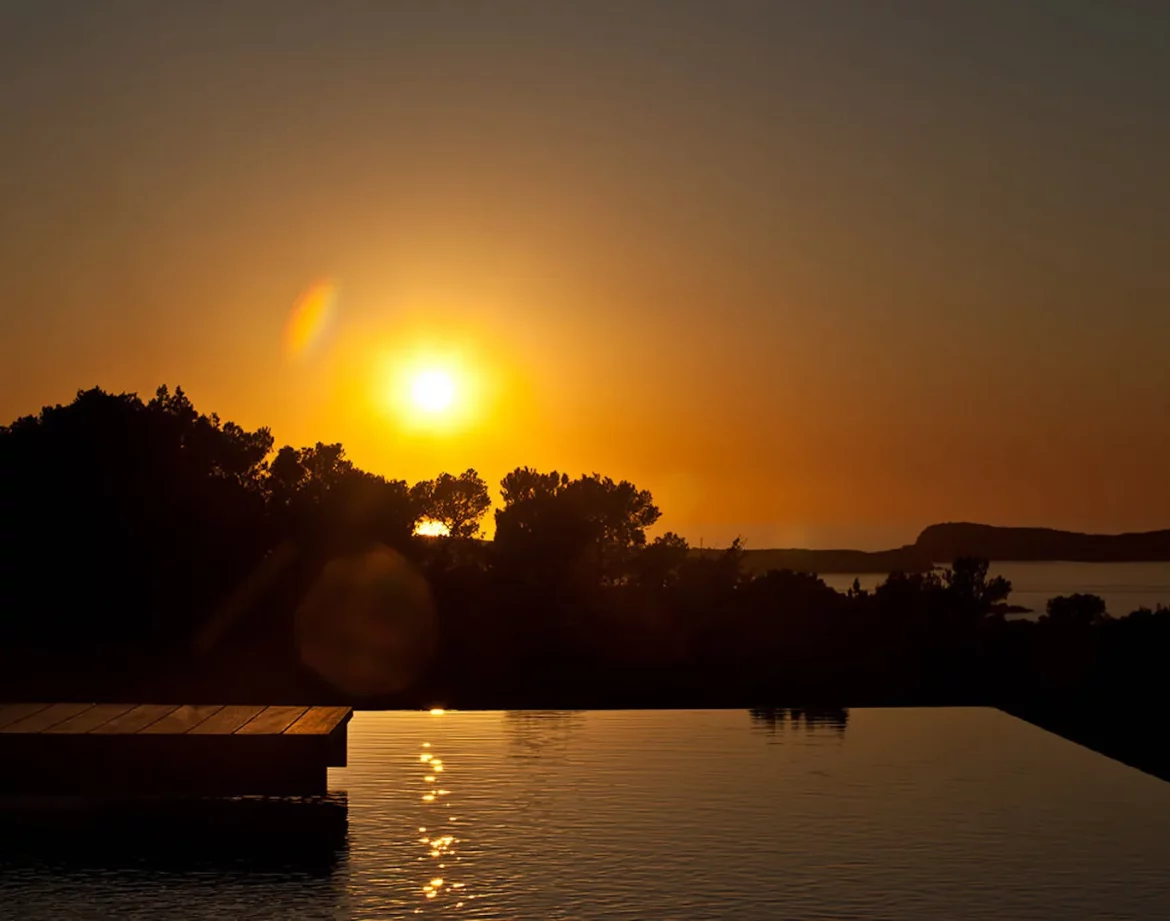
October is, for those who know the island well, one of the best months of the year. The quality of light changes and the colours of the landscape reach a particular intensity: a second flowering covers the island after the first rains of September, the sea retains all the warmth accumulated through the summer and the beaches recover a tranquillity that July and August do not allow. October sunsets in Ibiza are spectacular, and with nightfall arriving earlier, children too can enjoy that spectacle without sacrificing rest.
Read moreRestaurants remain open, beach chiringuitos continue to serve and the full range of island activities remains operational. What changes is the rhythm: the major clubs have closed their seasons by mid-month, and the profile of the visitor shifts. The Ibizans reclaim their island, restaurants operate with a warmer and more personal service and the sense of authenticity that summer dilutes returns to the fore.
For families whose school holidays coincide with October, it is an extraordinary option. For couples or travellers seeking quality of experience without the crowds, equally so. It is worth noting that the Anglo-Saxon tradition of Halloween, brought to the island by the British resident community, has taken firm root and generates its own atmosphere in the final week of the month.
What is the weather like in Ibiza in late September? Is it still good for swimming?
September is, in climatic terms, one of the best months of the year in Ibiza. Daytime temperatures remain around 25 to 28 degrees, the evenings are pleasant and the sea reaches its maximum annual temperature, between 24 and 26 degrees. Swimming in late September is not only possible: it is one of the finest experiences the island has to offer.
Read moreThe one nuance worth knowing is the weather shifts typical of the Mediterranean seasonal transition. Traditionally, the passage from summer to autumn would bring the island occasional intense rainfall episodes. Climate change has altered that pattern in unpredictable ways: some years the transition is smooth and dry, while occasionally more intense episodes occur. These are isolated circumstances, not a constant, and should not factor into the decision to visit the island during this period.
When should I book a luxury villa in Ibiza to get the best selection?
The most honest answer is: a year in advance. Luxury villa owners open their calendars applying current-year rates, and returning clients typically secure their preferred villa from one season to the next. This pattern of loyalty reduces the availability of the best properties before they have even been publicly listed.
Read moreFor those outside that circle, December and January concentrate a first wave of bookings, when many travellers plan their summer at leisure after the festive period. From April onwards, selection for July and August begins to narrow noticeably, and by May the best villas for the summer are often already committed.
Early booking is especially important when searching for a property with specific characteristics: sea views, a particular number of bedrooms, a specific location or particular facilities. The more flexibility a traveller has with dates, the more options will remain available even later in the season.
Is August in Ibiza too crowded even for luxury villa guests?
The perception of overcrowding in Ibiza during August deserves some nuance. In recent years it has been observed that the second half of the month is noticeably less busy than the first, partly because many families with school-age children are obliged to return home when the academic year begins.
Read moreMoreover, unlike other top-tier tourist destinations, Ibiza has a remarkable capacity to absorb summer footfall without generating the feeling of collapse that can be found in places like the coast of Saint-Tropez, notorious for its monumental traffic jams at beach exits. Neverland clients who have visited the island in August consistently report that it is perfectly possible to find moments of calm, to discover uncrowded corners and to enjoy the villa experience with complete privacy, regardless of the month. The villa, with its private pool, gardens and dedicated service, functions as a world apart from whatever is happening outside.
What is the shoulder season in Ibiza and when does it start?
The shoulder season in Ibiza encompasses two distinct periods within the year. The first runs from mid-May to mid-June, when the island is fully operational but demand has not yet reached its peak. The second begins in September, when the August crowds recede and the island recovers a calmer rhythm.
Read moreWithin those periods it is worth highlighting a particular phenomenon: they are the preferred months for weddings and private celebrations. Ibiza is one of the most sought-after destinations in Europe for this type of event, and many clients take advantage of the weeks of May, June and September to rent a villa for a celebration. This can affect the availability of certain properties, particularly the larger ones.
The low season proper runs from the end of October through to the following year’s Easter, with variations depending on when that holiday falls.
What is the difference between early season and peak season villa prices in Ibiza?
The difference can be very significant. Each luxury villa owner in Ibiza establishes their own pricing structure based on the positioning of the property, its location, its characteristics and its historical demand. There is no single reference price in the market.
Read moreThat said, the difference between a week in May and a week in August at the same villa can be double the rate or more. Some high-end properties maintain similar pricing between June and July, reserving the sharpest increase for August. Others apply a more gradual scale across the season. The key point for the traveller is that flexibility of dates has a direct and very significant economic value in Ibiza.
Is there a good time to visit Ibiza to avoid the worst of the crowds?
Any period of the season outside the last week of June and the first half of August allows the island to be enjoyed with considerably greater ease. May, September and October are the most recommended months for those who prioritise quality of experience over the animation of high summer.
Read moreThat said, as already noted, even in high season Ibiza retains a capacity to surprise. The island has a scale and a geography that allow quiet corners to be found even at moments of greatest footfall. The difference between a luxury villa with a private pool in August in Ibiza and a hotel at any other crowded destination is considerable.
What is the weather like in Ibiza in June compared to August?
June is a fully summer month in Ibiza, with average temperatures around 25 to 28 degrees and occasional heatwave episodes that can approach 30. The atmosphere is warm and luminous, but humidity has not yet reached the levels that characterise August. The evenings are pleasant and the sea is around 22 degrees, perfectly suited for swimming.
Read moreAugust raises those benchmarks across all parameters. Daytime temperatures regularly exceed 30 degrees, humidity reaches its annual peak and tropical nights are common. The heat index is more intense than in June not so much because of the temperature itself as because of the combination of heat and humidity. The sea, on the other hand, is at its finest: between 25 and 27 degrees, making swimming an exceptional pleasure.
For those sensitive to intense heat, or travelling with young children, June offers virtually the same conditions for enjoyment with considerably less climatic discomfort.
Is Ibiza good for a villa holiday in late April or early May?
It is an option that makes a great deal of sense and that more and more travellers are discovering. The island hosts several sporting events and international gatherings at that time of year, the landscape is at one of its most beautiful moments and temperatures are ideal for exploring the interior, hiking or simply enjoying the villa terrace without the burden of summer heat.
Read moreThe sea may feel a little cool for Mediterranean or Latin American travellers: around 17 to 18 degrees in April, rising towards 19 to 20 in May. Northern European travellers, accustomed to colder waters, find it perfectly comfortable. In any case, luxury villas equipped with heated pools remove that variable entirely.
The restaurant and service network is largely operational from Easter onwards, and villa and flight prices are well below those of high season. For travellers with flexible dates, it is one of the moments offering the best balance between quality of experience and cost.
When does the Ibiza villa rental season officially start and end?
Conventionally, the season begins with Easter and closes at the end of the October school holidays. Those two dates anchor the island’s tourist year: the progressive opening of hotels, restaurants and services coincides with the first, and the gradual closure of the hospitality sector coincides with the second.
Read moreIn the past, the opening and closing parties of the major clubs marked the beginning and end of the season with great clarity, carrying a symbolic weight that went beyond the purely commercial. That defined rhythm has given way to a more gradual opening and closing, which in practical terms has extended the season at both ends while diluting the moments of collective intensity that once characterised it.
What events or festivals happen in Ibiza in summer worth knowing about?
The Ibizan summer has a calendar of events that extends well beyond the clubbing circuit. In June, Ibiza Pride stands out as the great social and international gathering of the start of the summer, with several days of its own programming across the city. The night of San Juan, on 23 June, is one of the most deeply rooted traditions on the island: bonfires, music and fire rituals on beaches and in squares that draw mainly Ibizan residents, with a genuinely local character that tourist events rarely replicate.
Read moreIn August, the Fiestas de la Tierra are the patron saint festivities of Ibiza city and one of the most representative weeks of the local summer: music, folklore, popular activities and fireworks centred around the 5th and 15th of the month. At the end of August or beginning of September, the Eivissa Jazz festival takes place, the most culturally substantial event of the end of summer, with performances set against the incomparable backdrop of Dalt Vila.
The bulk of the clubbing programme, with its residencies and special nights, is distributed between June and early October following a calendar that updates continuously and is best consulted directly through the agenda of each venue.
Is the sea warm enough to swim in June in Ibiza?
Absolutely. The Mediterranean is a warm sea in general terms, and in Ibiza swimming is perfectly feasible from early May. In June, the water is around 22 degrees, a temperature that most swimmers find very pleasant. As summer progresses, the temperature rises steadily to reach between 25 and 27 degrees in August and September. Swimming in the Ibizan sea in June is not a sacrifice: it is one of the pleasures of the early season.
What is October like in Ibiza? Are restaurants still open? Are the beaches quiet?
October transforms Ibiza into a version of itself that many travellers consider the most authentic. A second flowering fills the island with colour after the rains of the seasonal change, the sea retains all the warmth accumulated during the summer and the beaches recover the tranquillity that allows one to stay until sunset without rushing. The October light in Ibiza has a particular quality: more golden, more horizontal, illuminating the landscape in a way that the overhead sun of summer does not allow.
Read moreRestaurants remain open and operate with a warmer and more personal service: the Ibizans have emerged from the intense rhythm of summer and their well-deserved rest season approaches. Beach chiringuitos continue to serve. What is no longer there are the major clubs, which have closed their seasons by mid-month.
The island in October is, in the words of those who know it well, the Ibiza without clichés: active, beautiful, open, but returned to its human scale.
Is there a sweet spot month for Ibiza that combines good weather and fewer crowds?
For those seeking that combination, May, September and October are the clearest answers. All three offer splendid weather, the island’s full service network in operation and a visitor density well below that of July and August.
Read moreMay has the advantage of the island in bloom and the lowest prices of the season. September adds the sea at its warmest of the year. October brings the golden autumn light and an authenticity that summer does not always permit. All three months share a quality that those who know the island particularly value: the space to enjoy Ibiza at one’s own pace, without the pressure of high season.
When do clubs open and close in Ibiza and does it affect villa pricing?
The major clubs in Ibiza open progressively from late April, with each venue and each residency setting its own opening dates across the following weeks. The end of the season is distributed between mid-September and mid-October, also in a staggered fashion.
Read moreThe influence of that calendar on luxury villa pricing is currently limited. The profile of the club-going public and that of luxury villa guests are distinct: the former typically seeks short stays and more accessible accommodation, while the latter values privacy and experience above the clubbing calendar. In the past, the single opening and closing weekends generated demand spikes that some owners incorporated into their pricing policy. With the dilution of those concentrated moments into a staggered calendar, that effect has lost its relevance.
What is Ibiza like in the low season, from November to March?
During the winter months, Ibiza adopts a completely different rhythm. Most hotels close, with the exception of a few urban establishments such as The Standard, Ibiza or the Montesol in the city. Restaurants reduce their activity or close temporarily. Villa owners use those months to carry out renovations, improvements and maintenance work.
Read moreThe profile of the winter visitor is primarily that of secondary residence owners spending periods on the island. Daytime temperatures hover between 15 and 20 degrees on sunny days, which can be very pleasant, though the characteristic humidity of the Mediterranean winter penetrates the bones of those unaccustomed to it, even when the cold is not severe.
In December, some clubs such as Pacha and DC10 open for New Year’s Eve celebrations. Christmas in Ibiza has its own particular atmosphere, and in recent years the tradition of a New Year’s Day swim on 1 January, inherited from Nordic resident communities on the island, has become well established. Some villas specially equipped with efficient heating, fireplaces and heated pools are rented for winter stays, though demand remains limited.
Is it possible to rent a luxury villa in Ibiza in winter?
Yes, though the supply is limited and demand modest. Some villas are specifically prepared for winter rental: efficient heating, fireplaces, heated pools and an interior comfort-oriented specification that summer does not require. The experience is very different from high season, but has its own appeal: the island in winter is quiet, luminous on clear days and extraordinarily peaceful. For those seeking a working retreat or complete disconnection, it is a little-known but genuinely worthwhile option.
What are the busiest weeks in Ibiza in summer and when to avoid them?
The weeks of highest tourist footfall are concentrated between the last week of June and the first half of August. This is the period when the school holidays of the main European source markets coincide, villa and flight prices reach their peak and property availability is at its most restricted.
Read moreFor those who cannot avoid those dates, it is worth remembering that Ibiza is not a destination that collapses in high season in the way other places do. With a good villa, the island experience is perfectly enjoyable even at moments of greatest activity.
Is late June better than early July for a family villa holiday in Ibiza?
Both periods are valid for a family stay. In late June the atmosphere is fully summery, the weather is excellent and footfall, while growing, has not yet reached its peak. In early July the pace increases, but the profile of arrivals at that time is largely family-oriented: many Australian, British and American travellers choose those weeks for their summer holidays.
Read moreThe difference in experience between late June and early July is smaller than many anticipate. The choice will depend more on availability at the chosen villa and the owner’s pricing policy than on any substantial difference in the character of the island.
The villas families choose, summer after summer
A selection of family-friendly villas in Ibiza for every moment of the season, from the first warm weeks of May to the golden calm of October.
The Ibiza full picture by Neverland
The destination
Areas and zones of Ibiza
Beaches and coves in Ibiza
Culture, history and authentic Ibiza
Sustainability and responsible tourism in Ibiza
Planning your stay
Prices and budget guide
Booking, trust and legal matters
Concierge and Housepitality in Ibiza
Island life
Ibiza for families with children
Gastronomy in Ibiza
Wellness and wellbeing in Ibiza
Category: encyclopaedia ibiza